
40 High-Strength Bicycle Spokes per Minute
Re-arrangement of modules enables precise straightening
The third generation of Amba’s All-in-One reducing machines further improves the straightness of single- and double-butted spokes – as used in electric and cargo bikes, for example. The new machines can produce up to 40 spokes per minute.
In the new machine generation, the rotary wire straightener has been re-arranged and is now positioned directly ahead of the cutter, behind the reducing section and the wire feeding unit. In this way, Amba avoids that transversal forces can act on the form-rolled wire during the feeding motion. Thus, the wire retains exactly the high level of straightness with which it leaves the straightener. At the same time, very tight roundness tolerances of just between two and three hundredths of a millimeter are attained.
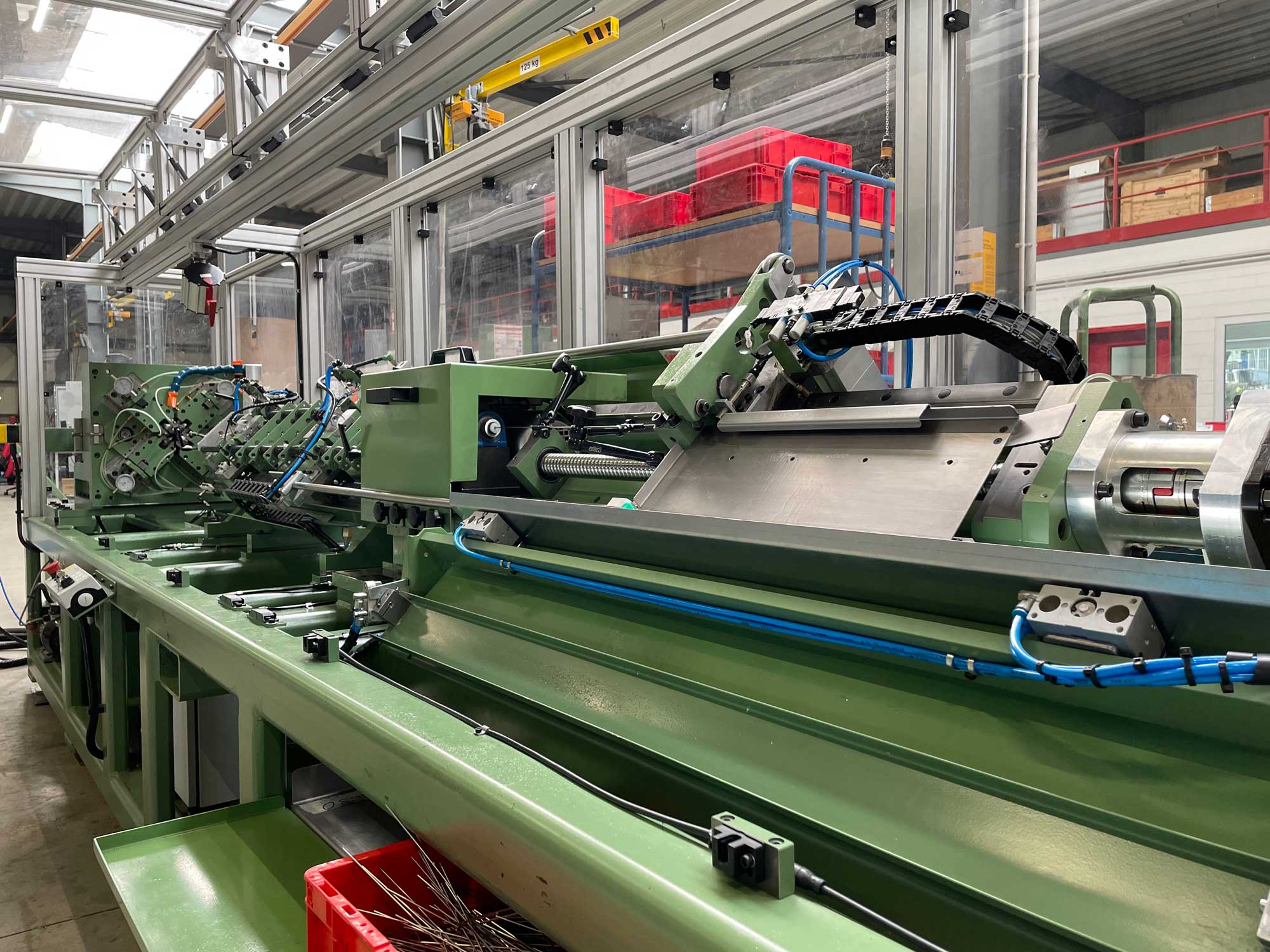
The All-in-One DD 350-III reducing machines can produce up to 40 single- or double-butted spokes.
According to Georg Haas, Sales Manager at Amba, the demand for this type of reducing machines has been rising lately: “The booming electric and cargo bike market has led to a growing demand for butted spokes. These are spokes that are thicker at one or both ends. Compared to non-motorized bicycles, spokes for these bikes are subjected to much higher loads because the bikes are ridden at higher speed and often used to transport heavy loads. Therefore, the spokes have to be able to cope with higher forces, especially during braking.”
Consequently, there has been increasing demand for single-butted spokes, i.e. spokes with a thick end at the hub and the usual diameter of 2 mm at the rim. For wheel manufacturers these spokes provide the benefit that – while the spoke-hub connection becomes strong enough to accommodate the higher torque – they can still use rims of standard design. Double-butted spokes, i.e. spokes with two thick ends, are predominantly used in high-end bicycles. The advantage of these spokes is that they save weight and reduce windage.
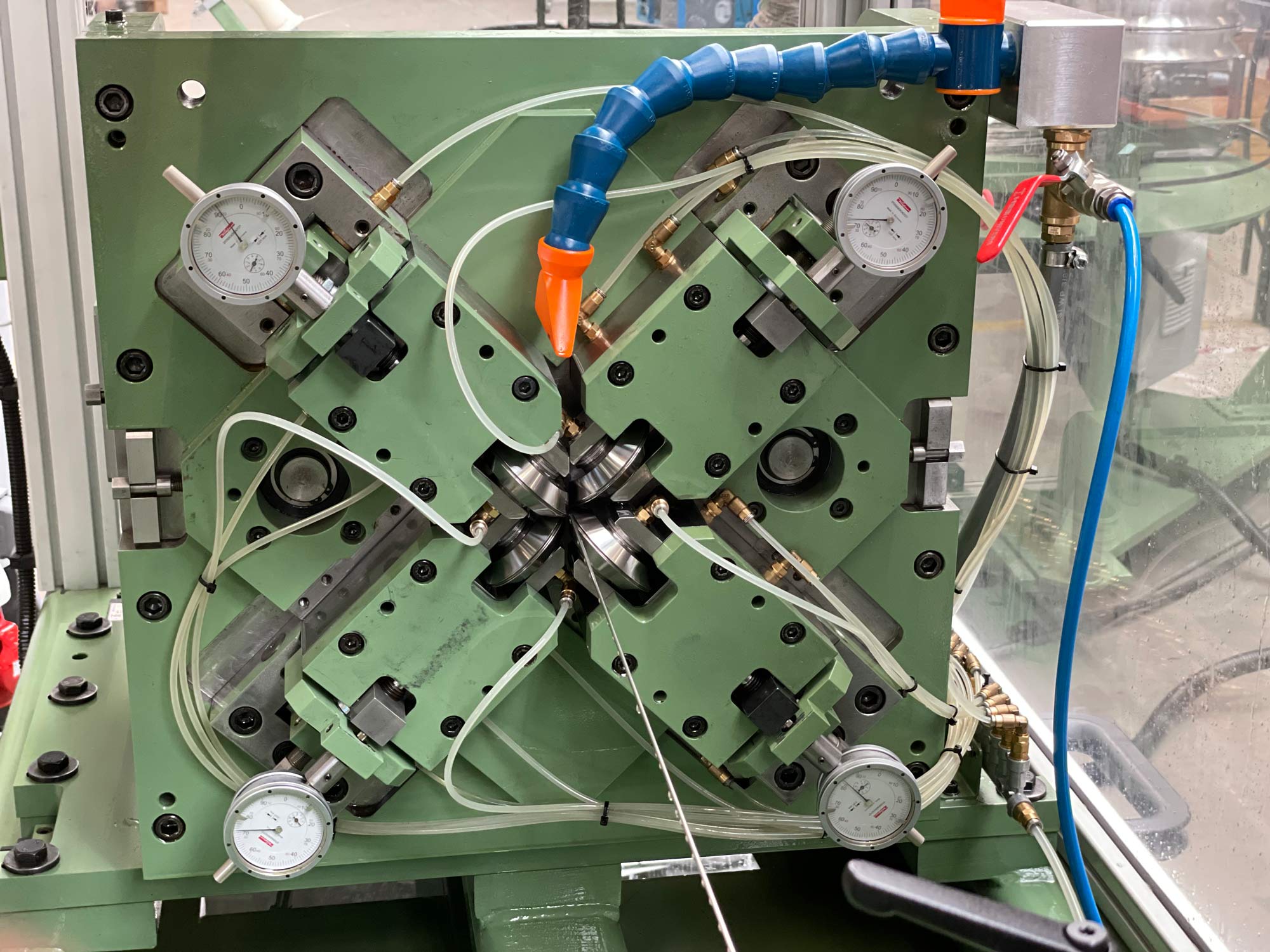
Servo-controlled actuators perform the radial movement of the two roll pairs positioned at 90° relative to one another.
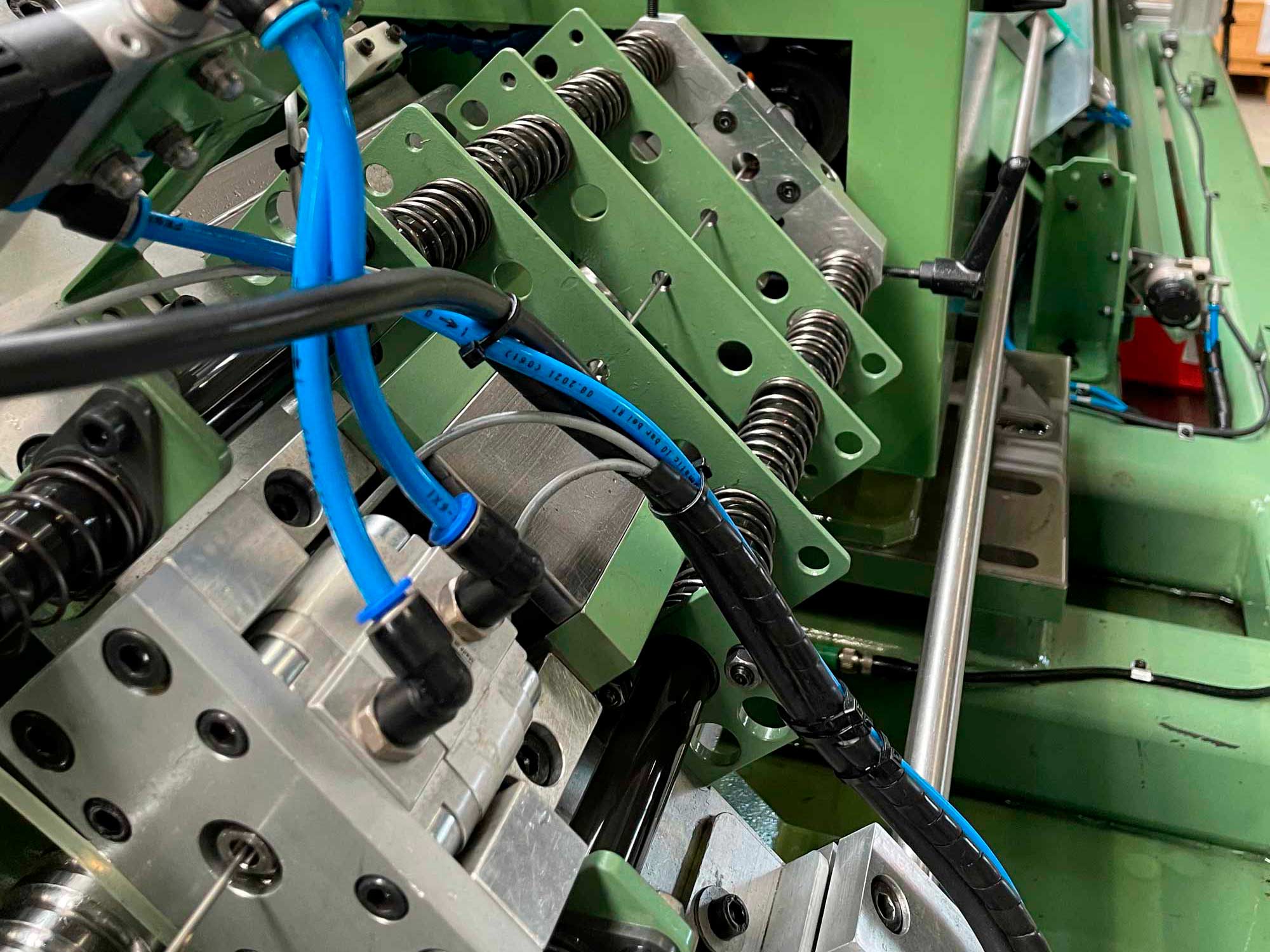
Servo-controlled ball screws actuate the slides that convey the wire through the various processing stages of the machine.
Like all Amba products, the new DD 350-III gauge reducing machine is designed as an All-in-One machine. All production steps from paying-off the wire to the finished blanks are performed within a single machine. We are the only supplier to use servo-controlled form-rolling in our machines. This process provides the benefit that the roll gap can be adjusted during the passage of the wire. Thus, it is possible to roll different, specific diameters – wherever desired – along the entire wire length. Cutting the wire after rolling within a thick section produces double-butted spokes. Cutting it at the end of a thin section produces single-butted ones.